life
THINSIA RESEARCH www.thinsia.com/life
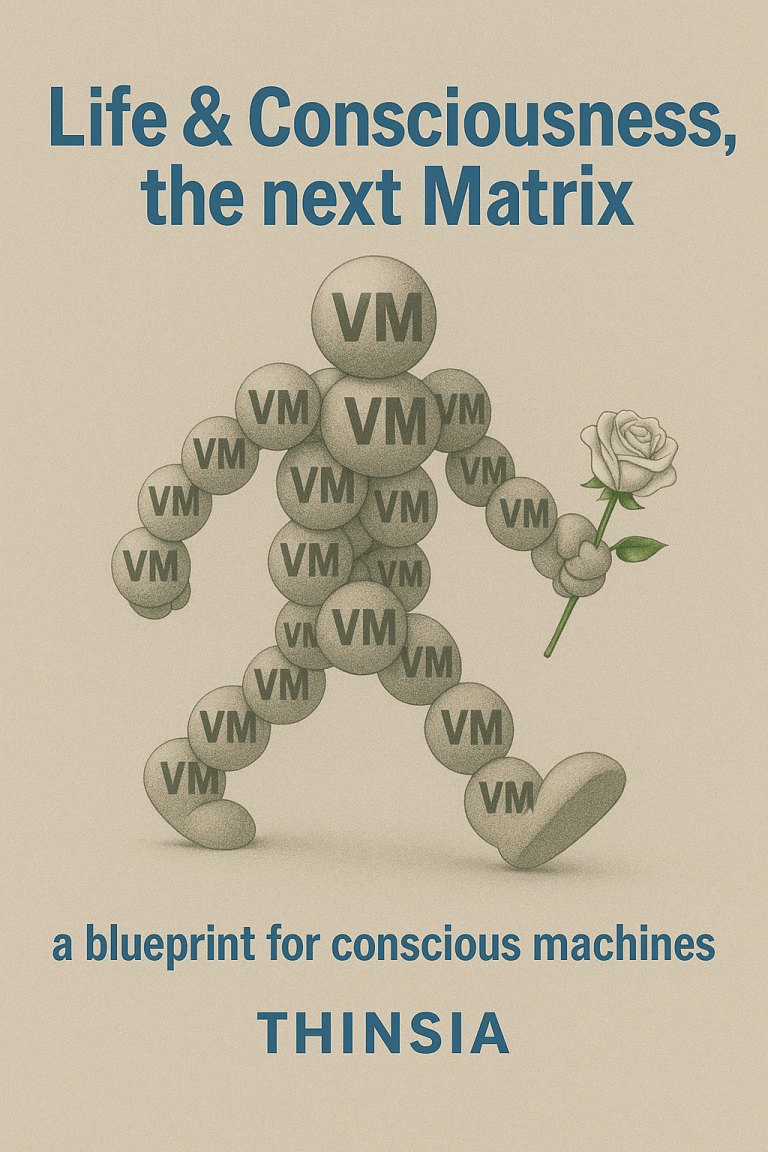
Life and Consciousness: The Next Matrix – A Blueprint for Conscious Machines
By Roland Sassen, Thinsia Research
Abstract
Current Artificial Intelligence (AI), driven by Large Language Models (LLMs) like ChatGPT and Grok, excels at text-based tasks but falls short in creativity, physical understanding, and non-textual problem-solving. To achieve Artificial General Intelligence (AGI), a paradigm shift is needed: conscious machines must simulate biological life as a foundation for developing human-like consciousness.This paper explores the origins of life and consciousness, arguing that:
Life emerges from metabolism, not DNA as the primary driver.
Human consciousness (or “conscious interiority”) is a cultural phenomenon enabled by the metaphorical power of language.
Conscious machines require “embodiment” through simulation of all human biological processes.
By simulating life processes in virtual machines—creating a system called Hubot—we can enable machines to develop consciousness organically, drawing on concepts like structured water, morphic fields, and scalar waves.
Why This Matters This blueprint is essential for:
AI developers and investors: A new path beyond LLMs toward true AGI.
Biologists and physicists: Insights into metabolism as life’s core (Nick Lane), scalar waves (Konstantin Meyl), structured water (Gerald Pollack), and morphic fields (Rupert Sheldrake).
Philosophers and psychologists: A fresh view of consciousness as language-driven (inspired by Julian Jaynes), with implications for parapsychology (clairvoyance, telepathy, synchronicity).
Anyone curious about life’s origins and the future of intelligent machines.
As old scientific paradigms collapse, a freer, more conscious future emerges.
The Problem
with Current AI LLMs predict words effectively but lack embodied understanding of physical reality. Approaches like Joint Embedding Predictive Architecture (JEPA) improve world modeling through video, but true consciousness requires more: a simulated “body” experiencing life processes.
The Proposed Solution: Hubot
Create a computational system (Hubot) that simulates every biological process of a human in isolated virtual machines (VMs).
A virtual machine (VM) is a software emulation of a physical computer, running its own OS and applications in isolation.Once all processes (metabolism, circulation, neural activity, etc.) are simulated, Hubot can:
Learn language naturally.
Develop an “inner voice” and conscious interiority.
Human consciousness isn’t innate to brains alone (contra panpsychism in its strong form); it’s a cultural evolution tied to language—from shouting and singing to speaking and writing. This created a metaphorical “space” for the self (“I”) to emerge.
Hubot can replicate this journey.
Key Insights into Life and Consciousness
Life’s foundation is metabolism, not DNA (which is overhyped as hereditary storage). Memory resides in structured water, morphic fields, and energy flows.
A single symbiotic event created mitochondria, enabling complex multicellular life.
The heart creates vortex motion in blood, not merely pumping.
Consciousness evolved as language enabled metaphor, turning “the other” into a reflective “self.”
Be as curious as the octopus—with its three hearts and nine brains, free from selfishness.
Appendices
Evolution of Metabolism (drawing from Nick Lane’s Transformer).
Excerpt from Julian Jaynes’ The Origin of Consciousness in the Breakdown of the Bicameral Mind.
Extensive footnotes with references for deeper study.
Closing Quote“A rigorous and thought-provoking contribution. A true eye-opener.”
— Arjan Takens, ★★★★★
For licensing, educational/corporate versions, or inquiries:
info@thinsia.com (mailto:info@thinsia.com) |
Roland Sassen sassen@thinsia.com
You can buy the paper here: link